Mao Feng
Mao Feng, most often encountered as Huangshan Maofeng or 'Yellow Mountain Fur Peak,' is a celebrated Chinese green tea made from the unoxidized buds and tender young leaves of the tea plant. Its name describes both the fine white down covering the leaves and their processed shape, which is said to resemble a mountain peak.
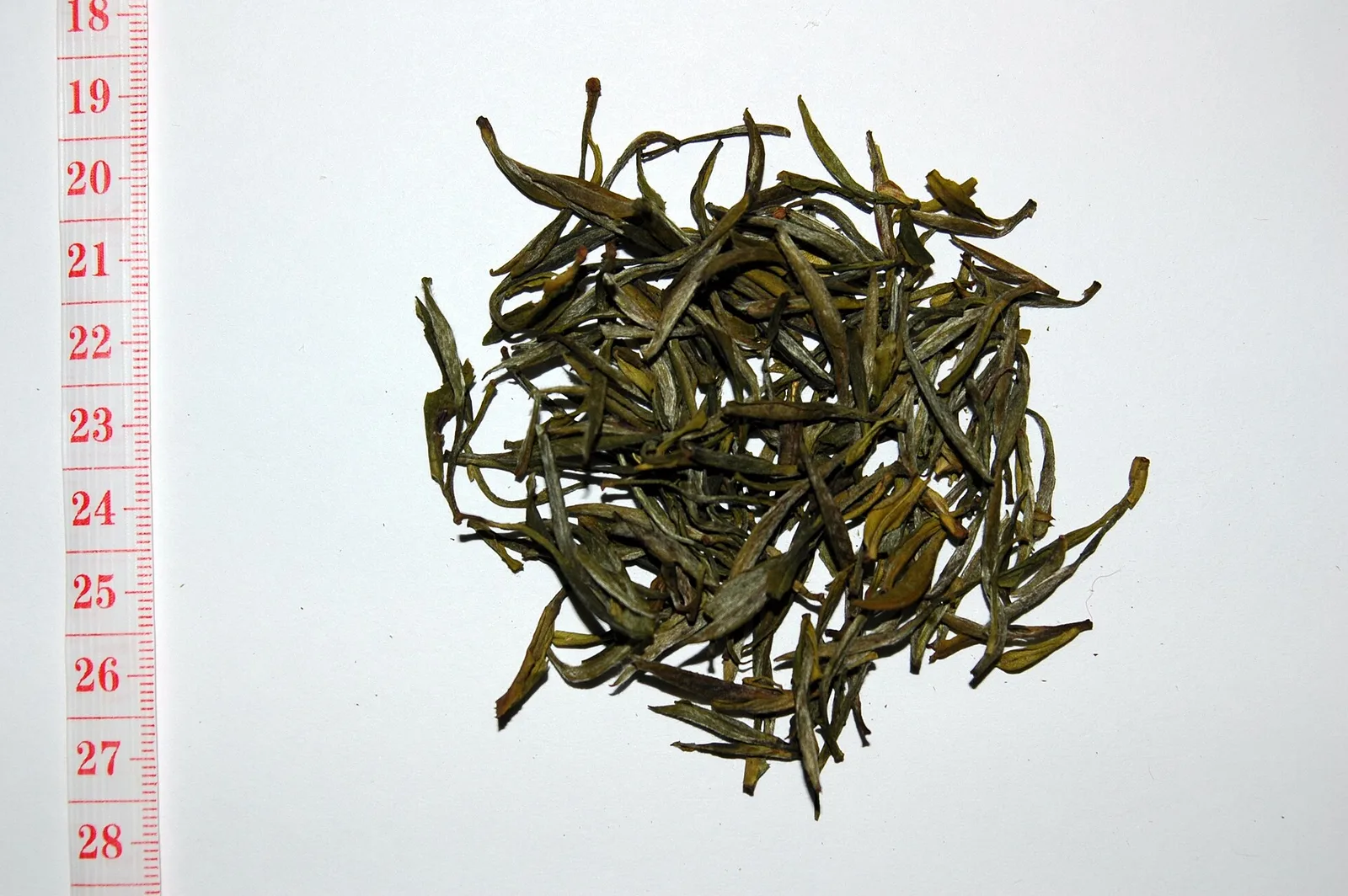
How mao feng is prepared
It is prepared chiefly as a hot infusion of whole leaves in water below boiling, often steeped several times. As a fine green tea it also serves as a base for scented teas, as a starting tea for fermented drinks such as kombucha, and increasingly as an iced or chilled infusion.
Tea Fermentation
The controlled microbial or enzymatic transformation of tea leaves, an experimental R&D direction for developing complex flavors beyond distillation alone.
In depth
Origins on Yellow Mountain
Mao Feng is a green tea grown in the mountainous southeast of Anhui province in China, on and around the slopes of Huangshan, the Yellow Mountain. Its full name, Huangshan Maofeng, is often rendered in English as 'Yellow Mountain Fur Peak,' a reference both to the downy white hairs on the leaves and to the peaked shape the leaves take after processing. The most prized lots are gathered in early spring, before the Qingming Festival, when only the new bud and the single adjacent leaf are plucked; local growers liken the appearance of these leaves to orchid buds. Counted among China's most famous teas, Mao Feng is, in its primary use, a tea destined to be infused in hot water and drunk on its own.[1]
A green tea in the Chinese tradition
As a green tea, Mao Feng is made from leaves and buds that are kept from withering and oxidizing, the steps that would otherwise turn the leaf into oolong or black tea. Green tea of this kind arose in China in the late first millennium BC and has remained the country's most widely produced style. After the early Ming period, Chinese green teas including those of the Huangshan region were typically fixed by pan-firing in a dry wok rather than steamed, a method that helped shape their flavor. The result is a brew low in calorie content and rich in the polyphenols and caffeine characteristic of green tea, valued above all as a clean, fresh drink.[2]
Brewing and serving as an infusion
The classic way to enjoy Mao Feng is by steeping the loose leaves in hot water. Higher-grade green teas of this sort are generally brewed with cooler water and for shorter times than ordinary teas, and good leaves can be re-steeped two or three times, each infusion yielding a slightly different cup. Water that is too hot or contact that is too long draws out excess tannins and turns the brew bitter and astringent, so careful control of temperature and timing is part of getting the best from a delicate tea like this. Warming the pot beforehand and adding fresh hot water gradually are among the techniques used to preserve the tea's gentle, floral character.[2]
A place in Chinese tea culture
Mao Feng sits within a tea culture that emerged in the Tang dynasty and flourished thereafter as both a daily pleasure and a refined art. In this tradition, drinking tea moved from being a medicinal or food preparation toward a social and contemplative practice, with the spring harvest and the finest mountain-grown leaves especially esteemed. Tribute teas from celebrated mountain regions were historically reserved for emperors and the elite, and the prestige attached to teas from named peaks survives in the reputation of a tea like Huangshan Maofeng. Tea continues to be served on both casual and formal occasions in China, and high green teas of this kind remain central to that hospitality.[3]
As a base for scented teas
Because Mao Feng is a clean, fragrant green tea, it can serve as the foundation for scented teas, most famously jasmine tea. Jasmine tea may be built on any tea base, but green tea is among the most common, and the practice of perfuming tea leaves with jasmine blossoms in China dates back many centuries, becoming widespread by the Qing dynasty as tea was exported westward. In the scenting process, freshly picked jasmine flowers are layered with or blended into the tea overnight so the leaves absorb the floral aroma, after which the tea is dried again; for top grades the process may be repeated several times. A delicate green tea like Mao Feng lends itself well to this kind of gentle floral enhancement.[4]
As a starting tea for fermented drinks
Beyond infusion, green teas such as Mao Feng can supply the brewed tea base for kombucha, a lightly fizzy fermented tea drink believed to have originated in China before spreading to Russia, Eastern Europe, and eventually around the world. Kombucha is made by steeping tea in sugared water, discarding the leaves, and fermenting the sweetened liquid with a symbiotic culture of bacteria and yeast. While the drink is most classically associated with black tea, green tea is also used and influences the color and character of the finished beverage. The result is a low-alcohol drink, generally under half a percent alcohol by volume in commercial form, that has become a popular non- and low-alcohol specialty beverage.[5]
Modern global use
Today Mao Feng is enjoyed both within China and internationally, carried by the broad modern demand for green tea. China supplies the great majority of the world's green tea, and the spring-picked, bud-and-leaf style that Mao Feng exemplifies represents the premium end of that market, with the earliest harvests commanding the highest prices. Contemporary drinkers use such teas not only as the traditional hot infusion but also chilled and iced, and as the flavoring foundation for blended and fermented tea beverages. Its clean profile and floral note make it a versatile choice across the growing world of brewed and infused non-alcoholic drinks.[2]
Part of Green Tea
References
- [1]EncyclopediaHuangshan Maofeng — Wikipedia↑§1
- [2]EncyclopediaGreen tea — Wikipedia↑§2↑§3↑§7
- [3]EncyclopediaChinese tea culture — Wikipedia↑§4
- [4]EncyclopediaJasmine tea — Wikipedia↑§5
- [5]EncyclopediaKombucha — Wikipedia↑§6