Lapsang Souchong
Also known as: lapsang, zhengshan xiaozhong
Mature broad leaf tea finished over pinewood fire
Lapsang Souchong is a smoke-dried black tea made from the leaves of the tea plant, distinguished by drying the leaves over a pinewood fire. The smoking may be done as a cold smoke of the raw leaves during processing or as a hot smoke applied to leaves that have already been withered and oxidized. It is brewed as a full-bodied, smoky-tasting infusion that is not bitter and rarely needs sugar.
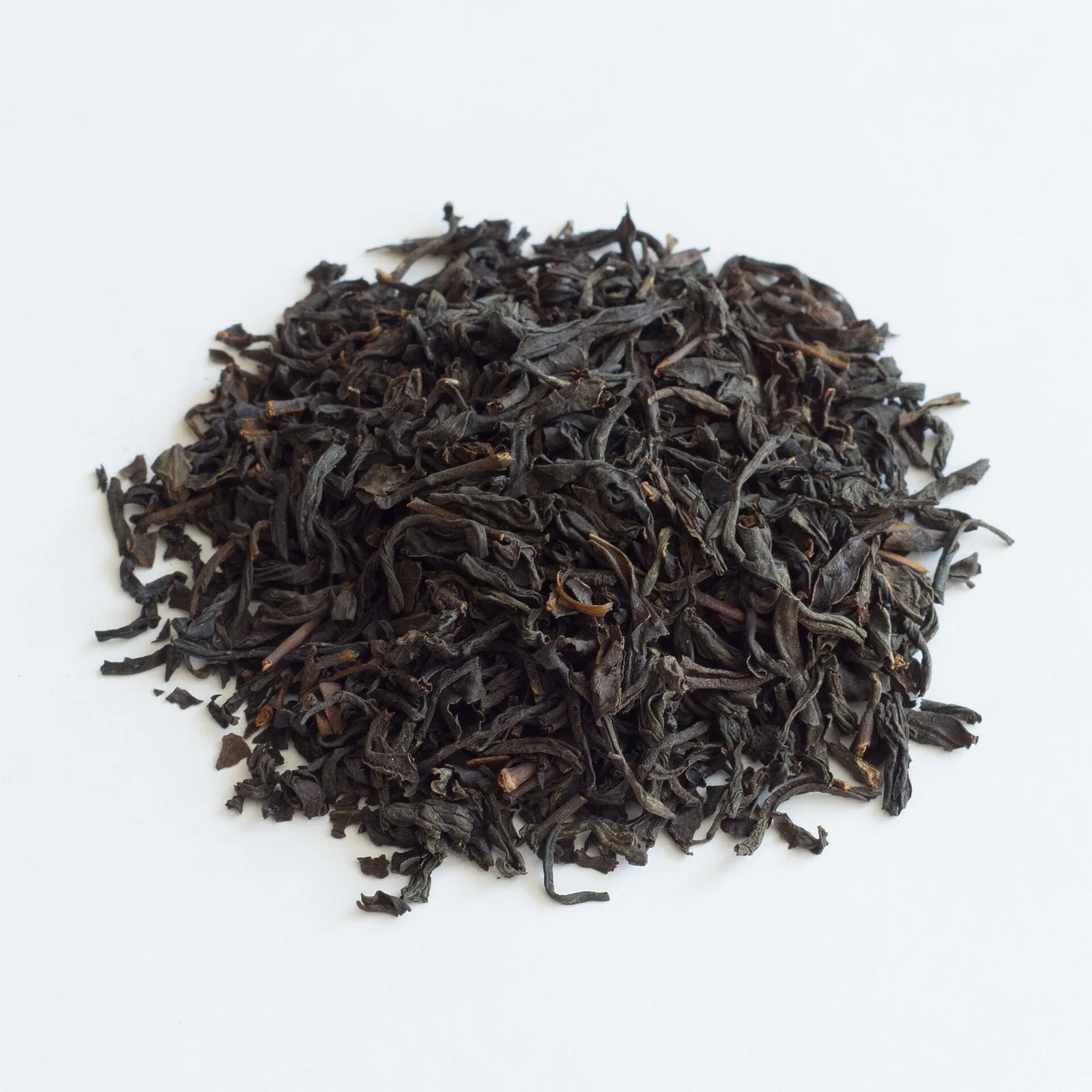
How lapsang souchong is prepared
Drunk on its own as a brewed black tea (with or without milk), used to add smoke and body to blended black teas such as Russian Caravan and smoky variations on bergamot tea, and increasingly used as an aromatic backbone in non-alcoholic and low-alcohol cocktail-style drinks and cold infusions. An unsmoked variety, popular in the Chinese domestic market, is also brewed as a delicate black tea.
Tea Fermentation
The controlled microbial or enzymatic transformation of tea leaves, an experimental R&D direction for developing complex flavors beyond distillation alone.
In depth
Origins in the Wuyi Mountains
Lapsang Souchong took shape in the Wuyi Mountains of northern Fujian, where both black and oolong teas are thought to have first been made. Known in Chinese as Zhengshan xiaozhong, it belongs to the family of Wuyi teas long traded under the English name Bohea. Popular accounts place its creation during the Qing dynasty, with one durable story holding that, around the mid-seventeenth century, tea farmers fleeing advancing soldiers hastily dried freshly plucked leaves over pinewood fires to keep them from spoiling. The resulting smoky tea, far from being rejected, found eager buyers, and the smoke-drying that began as expedient preservation became its defining signature. Whatever the truth of the legends, the tea emerged as one of the earliest distinctively dark, oxidized teas of the region.[1]
How the tea is made and brewed
As a drink, Lapsang Souchong is processed much like other black teas but with smoke woven into the production. The traditional method confines the leaves within a smoke house, where they wither on bamboo mats, are rolled to start oxidation, oxidize in cloth bags, and finally dry for many hours in pine smoke; a more industrial version partially processes leaves elsewhere before hot-smoking them at a central facility. Pine is the classic fuel, though cedar and cypress are sometimes used, and the intensity of the smoke can be tuned by leaf choice and by placing batches nearer or farther from the fire. It is brewed like other black teas, with near-boiling water for a few minutes, yielding a lingering smoky liquor that can be taken plain or with milk and seldom needs sweetening.[2]
Entry into the European tea trade
Lapsang Souchong reached the West through the early modern tea trade out of southern China. European merchants buying tea at Canton in the seventeenth century grouped the more oxidized Fujian teas under the blanket name Bohea, before the categories of black and oolong came into use. As distinctions sharpened, the smoky souchong leaf was traded separately, often at a premium, under the name Souchong. The long sea voyage to Europe favored heavily oxidized teas that held their quality, and a faint smokiness was thought to suit the well-traveled product. Souchong teas figured among the imports carried to colonial America by the British East India Company, and chests of souchong were among the cargo destroyed in the protest known as the Boston Tea Party.[1]
The Russian caravan tradition
Among smoky-tea cultures, the most enduring is the Russian one. The blend known as Russian Caravan pairs a base of Keemun, and sometimes Dianhong, with a measure of smoky Lapsang Souchong and occasionally roasted oolong. The smoke evokes the overland tea caravans that carried Chinese tea to Russia in the nineteenth century, the leaves supposedly catching the scent of campfires along the months-long route. Russian-labeled blends remain a natural home for the tea, frequently rounded out with spices and citrus, and Lapsang Souchong continues to supply the campfire note that defines the style.[3]
British associations and blended teas
In British tea culture, Lapsang Souchong gained a reputation as a distinctive, somewhat aristocratic drink, popularly tied to figures such as Winston Churchill who were said to favor it. Beyond being brewed on its own, it serves as a blending component, lending fuller body and a more robust aroma to black-tea mixtures; it is sometimes folded into bergamot-scented teas to add a smoky dimension to a citrus-forward style. Because tea readily absorbs aromas, smoking is treated as one of several ways of flavoring tea leaves, alongside scenting with flowers, fruit, and spices, and the best smoked souchongs are prized for keeping subtlety rather than being overwhelmed by smoke.[3]
Contemporary use and the unsmoked turn
Today Lapsang Souchong occupies two roles in beverages. The classic smoked tea remains a favorite for its bacon-like aroma and whisky-like depth, drunk hot, served iced, and increasingly used by drinks makers as an aromatic base for non-alcoholic and low-alcohol creations where its smoke stands in for spirit or peat. At the same time, since the early twenty-first century an unsmoked version developed in the village of Tong Mu Guan, made even with the prized young leaves and bud, has grown popular, especially within China, as a refined black tea brewed without any smoke at all. Production continues in Fujian and in Taiwan, the latter known for a more heavily smoked style.[2]
Part of Black Tea
References
- [1]EncyclopediaWuyi tea — Wikipedia↑§1↑§3
- [2]EncyclopediaLapsang souchong — Wikipedia↑§2↑§6
- [3]EncyclopediaTea blending and additives — Wikipedia↑§4↑§5