Strawberry
The garden strawberry is a fragrant, bright red aggregate fruit valued for its sweetness, juicy texture, and intensely fruity aroma. Its appealing flavor and color make it one of the most widely used fruits in beverages, whether as fresh fruit muddled into drinks, as puree, as syrup, or as a fermentable ingredient.
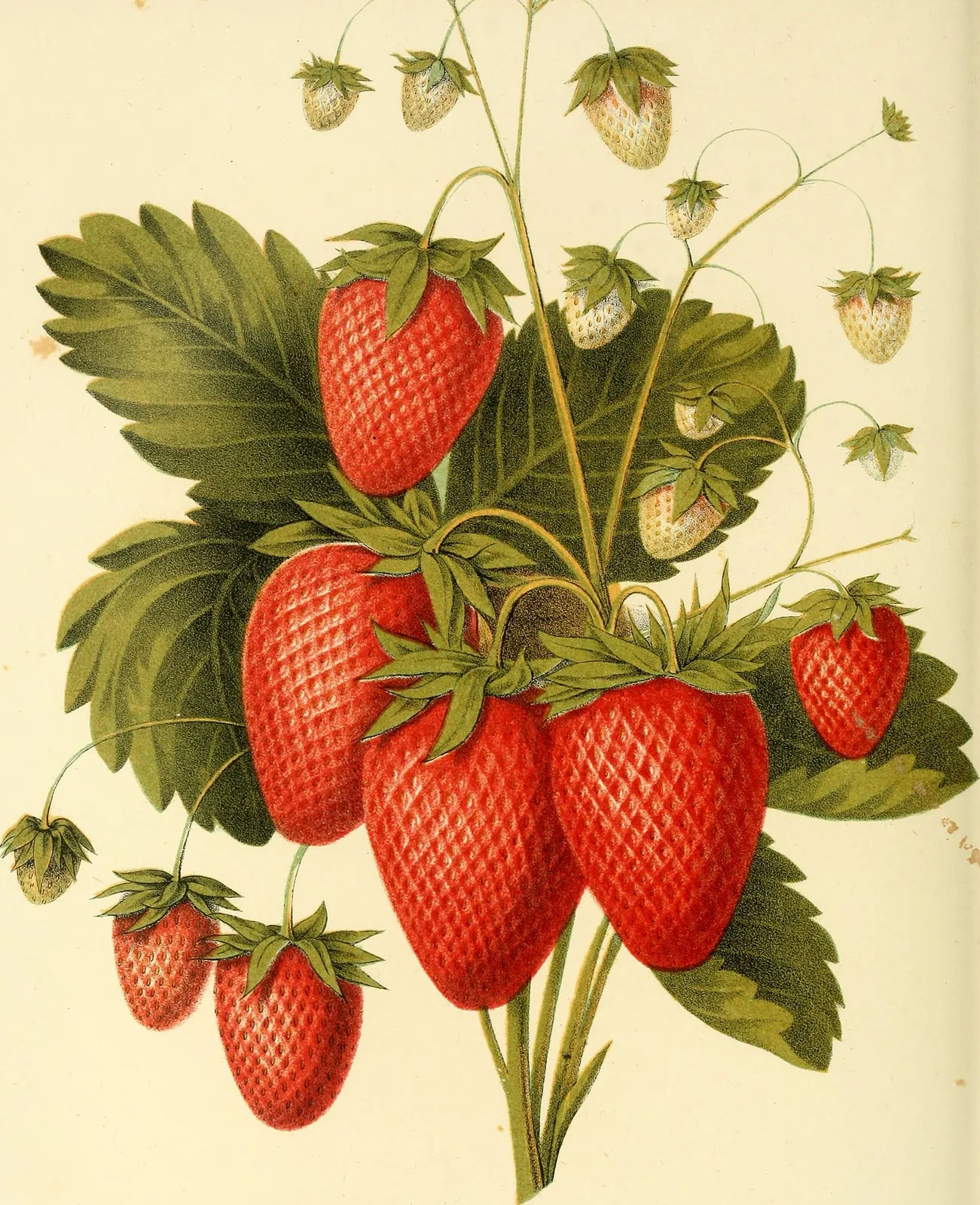
How strawberry is prepared
Strawberries are added to fermented drinks such as fruit lambics and fruit wines, blended into flavored milks and milkshakes, muddled or pureed into cocktails like the strawberry mojito and strawberry daiquiri, and widely used as syrup or flavoring in soft drinks, smoothies, and frozen drinks.
Carbonic Maceration
An intracellular fermentation in which whole, uncrushed fruit is sealed in a CO2-rich, oxygen-free vessel so each berry ferments from the inside out. Adapted from natural winemaking for non-alcoholic blends.
Lacto-Fermentation
Fermentation by lactic-acid bacteria, which convert sugars into lactic acid for a clean, savory acidity.
Other preparations
In depth
From wild forest fruit to a cultivated berry for drinks
For much of European history, strawberries used in food and drink were small wild or woodland berries gathered from forests and transplanted into gardens, propagated by pegging down their runners. The fruit prized today is a relatively recent creation: a hybrid first raised in Brittany, France, around the 1750s, combining a vigorous Chilean species carried back to Europe in 1714 with a North American one. Once this larger, sweeter berry spread through cultivation, it became far more practical for flavoring, sweetening, and fermenting beverages. Its aroma, dominated by esters, furans such as furaneol, and terpenes, is precisely the quality that makes it so attractive in drinks, and that same aromatic appeal has made strawberry one of the most heavily reproduced flavors in manufactured beverages, perfumes, and foods.[1]
Strawberry wines and the Venetian fragolino tradition
Strawberries themselves are fermented into fruit wine, a sweet, fragrant style produced in many regions where the berry grows. A distinct but related Italian tradition centers on fragolino, a sparkling red wine from the Veneto made not from strawberries but from the so-called strawberry grape (uva fragola), a non-vinifera American vine introduced to Europe in the nineteenth century during the phylloxera crisis. Venetian winemakers found the grape made a delicious, sweet, refreshing summer wine with a delicate strawberry-like aftertaste, and because it was cheap it became locally popular. Commercial sale of true fragolino was later restricted within the European Union, owing in part to difficulties controlling methanol levels in its production, making the authentic article hard to obtain.[2]
Strawberry in Belgian lambic brewing
In the Pajottenland region of Belgium, southwest of Brussels, the spontaneously fermented beers known as lambic have been brewed since at least the thirteenth century. Lambic is exposed to wild yeasts and bacteria during overnight open-air cooling, then matured for one to several years in wooden barrels, yielding a dry, tart, cidery beer. A long-standing practice is to refement lambic with fruit, and while cherry (kriek) and raspberry (framboise) are the most famous, strawberry (aardbei) is among the fruits also used, added as whole fruit or syrup. Traditional fruit lambics are dry and sour, though many widely sold modern fruit versions are sweetened, carbonated, and based on juice rather than whole fruit, and are regarded as lower in quality by enthusiasts.[3]
Strawberry in flavored milk and dairy drinks
Strawberry is one of the classic flavors of sweetened dairy drinks, alongside chocolate, vanilla, and banana. Flavored milk is made by combining milk with sugar, flavorings, and sometimes coloring, and is sold either chilled and pasteurized or as a shelf-stable ultra-high-temperature product, as well as being mixed fresh at home or in food service. In parts of the United States, particularly New England, milk blended with strawberry or chocolate syrup in a mixing machine is itself called a milkshake. Flavored milk consumption is especially high in Australia, and strawberry-flavored versions are a familiar everyday drink for children and adults alike, though such products have drawn criticism for their added-sugar content.[4]
Strawberry in the mojito and rum-based drinks
The mojito, a traditional Cuban punch built from white rum, lime juice, sugar, mint, and soda water, has spawned many fruit-forward variations, among them the strawberry mojito, which incorporates muddled fresh strawberries into the classic mixture. A further variant along these lines swaps gin for the rum and lemon juice for lime, adding tonic. The same impulse to brighten a rum drink with fresh fruit appears across Latin American and Caribbean bar culture, where added fruits and purees are used to enhance the base cocktail. In its alcohol-free form a mojito is known as a virgin mojito or nojito, and a strawberry version translates readily into a no- and low-alcohol drink, keeping the mint, lime, sugar, and soda while leaning on the berry for body and color.[5]
The strawberry daiquiri and frozen drinks
The daiquiri, a Cuban cocktail of rum, citrus juice, and sugar associated with the iron-mining region near Santiago de Cuba around the turn of the twentieth century, gave rise to one of the most recognizable strawberry drinks. A strawberry daiquiri is a blended drink of pureed whole strawberries with rum, cane sugar, and lime juice, part of a broader family of frozen, fruit-flavored daiquiris made with finely crushed ice in a blender to a smoothie-like texture. There is also an older strawberry-tinged predecessor, the Old Rose daiquiri, which used strawberry syrup. These frozen and fruit daiquiris are commonly produced at scale in slush machines in many flavors, and the strawberry version adapts easily into non-alcoholic frozen drinks by omitting the rum while retaining the puree, ice, sugar, and lime.[6]