Raspberry
A fragrant red bramble fruit of the rose family, prized in drinks for its perfumed aroma and balance of sweetness and tartness. It performs as a fresh juice, a syrup, a fermenting fruit, and a flavoring across both alcoholic and non-alcoholic beverages.
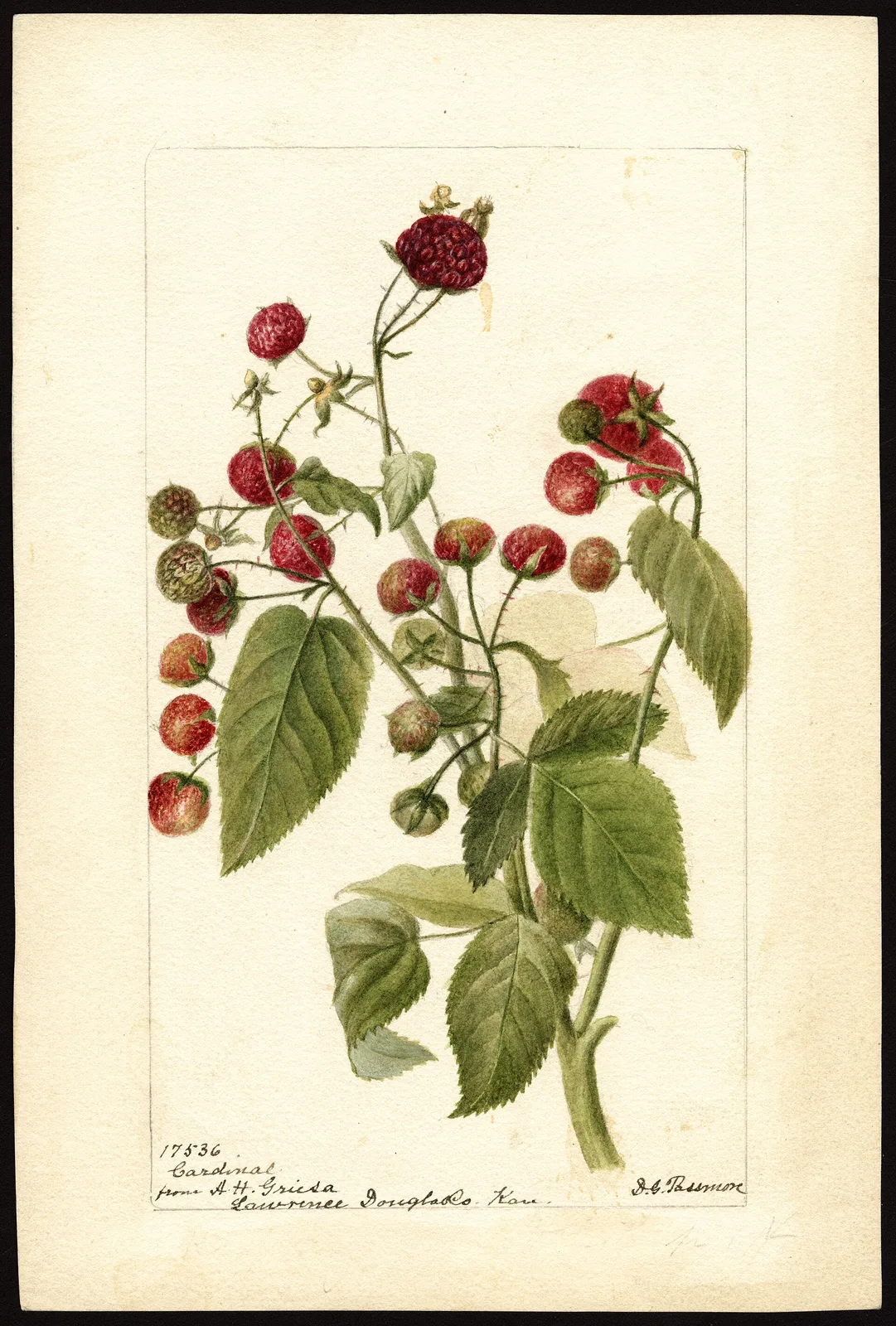
How raspberry is prepared
Used as whole fruit or syrup to refement and flavor sour beers (notably Belgian framboise lambic), as a base for fruit wines, as a fruit liqueur for cocktails such as variations on the Kir, as a flavoring for fermented grain drinks like kvass, and as juice, purée, and cordial in countless non-alcoholic sodas, shrubs, and infusions.
Carbonic Maceration
An intracellular fermentation in which whole, uncrushed fruit is sealed in a CO2-rich, oxygen-free vessel so each berry ferments from the inside out. Adapted from natural winemaking for non-alcoholic blends.
In depth
A wild northern fruit and its name
The raspberry grows wild across the temperate north of Europe and Asia, with a sibling species native to North America, and humans have gathered and later cultivated it for centuries. It is the edible aggregate fruit of several bramble species in the genus Rubus, most belonging to the subgenus Idaeobatus; the familiar European red raspberry is Rubus idaeus. Intriguingly, the English word itself carries a drinks connotation: the "rasp" element traces back to raspise, a sweet rose-colored wine recorded in the mid-fifteenth century, suggesting that the berry was associated with beverages even at the level of language. Tart and high in acid yet markedly aromatic, the fruit has always lent itself to liquids—juices, syrups, preserves dissolved in water, and liqueurs—as much as to eating out of hand.[1]
Belgian framboise: raspberry in spontaneously fermented beer
The most storied brewed use of raspberry comes from the Pajottenland region southwest of Brussels, where lambic beer has been made since the medieval period. Lambic is fermented not with cultivated brewer's yeast but through exposure to the wild yeasts and bacteria of the Zenne valley, giving a dry, cidery, often sharply sour beer. Brewers traditionally refermented lambic on fruit, and while sour cherry (kriek) is the oldest such style, raspberry gives framboise—from the French word for the berry. The fruit, added as whole berries or syrup, triggers a secondary fermentation, usually completed in the bottle. Traditional examples are tart and vinous, though many commercial framboise beers are sweetened to be more approachable. The technique has traveled: brewers elsewhere now make raspberry-flavored sour and wild ales in the spirit of the Belgian original, sometimes on a base other than true lambic.[2]
The framboise tradition beyond lambic
Although framboise is most closely tied to lambic, the term simply denotes a Belgian-style beer fermented with raspberry, and the family of fruit beers it belongs to is broader than a single recipe. It is conventionally served in a short, footed glass resembling a small champagne flute, a presentation that signals its festive, vinous quality. Most bottled framboise beers lean sweet, but tart, drier interpretations exist that hark back to the austere old kriek style. Not every raspberry beer rests on a lambic base—some are built on an aged brown ale (oud bruin), yielding a distinctly different, deeper-toned result. Across these variations, raspberry functions as both a flavoring and an active fermentable, its acidity reinforcing the sourness already characteristic of these beers.[3]
Raspberry in French aperitif culture
In France, raspberry entered drink culture chiefly through fruit liqueurs and the aperitif tradition. The classic Kir, a Burgundian aperitif of crème de cassis topped with white wine, has long admitted substitutions: a French waiter taking an order may ask whether the customer prefers it built with blackcurrant, blackberry, peach, or raspberry liqueur (framboise). When raspberry liqueur replaces cassis and the wine is sparkling, the drink becomes a Kir impérial. Related sparkling-wine variations, such as a royale-style mix involving raspberry liqueur and an edible hibiscus flower, also draw on the berry's perfume. In these drinks the raspberry's role is to perfume and lightly sweeten an otherwise crisp wine base, making it a fixture of pre-meal drinking.[4]
Raspberry wine and the country-winemaking tradition
Raspberry has long been a staple of fruit, or "country," wines—fermented beverages made from fruit other than grapes. Such wines have been especially popular with home winemakers and in cool-climate regions like North America and Scandinavia, where good wine grapes are hard to grow but berries flourish. Raspberry is among the fruits that winemakers single out for their high natural acidity: like strawberries, cherries, and pineapples, the berry is often too sharp to ferment undiluted, so the mash is typically topped up with water to soften the acid to pleasant levels. Because this dilution also thins out flavor, makers commonly back-sweeten the finished wine with sugar, which doubles as a flavor enhancer. The same logic carries into raspberry dessert wines and fruit "ports," which push residual sugar and alcohol higher for a richer style.[5]
Raspberry kvass and Eastern European fermented drinks
In Eastern Europe, raspberry found its way into kvass, the cloudy, low-alcohol fermented beverage of cereal origin that has been a daily drink across the Slavic world and beyond since at least the tenth century. Traditionally based on rye bread or rye flour and malt, kvass readily takes on fruit, herbs, berries, and honey, and as the drink commercialized in the second half of the nineteenth century, a wide range of flavored versions proliferated—more than 150 varieties were recorded, among them raspberry alongside apple, pear, mint, lemon, chicory, and cherry. In the Lithuanian tradition of gira, a kindred drink, country makers likewise fermented berries and fruit with bread or rye malt. Here raspberry serves as a seasonal flavoring layered over a grain ferment, lending fragrance and color to a refreshing, barely alcoholic beverage.[6]
Raspberry in the modern drinks repertoire
Today raspberry is among the most widely used berries in beverages worldwide, cultivated heavily across northern Europe and North America and processed at scale into juice, purée, and individually quick-frozen fruit destined for the drinks trade. Its bright, perfumed character suits it to soft drinks, cordials, shrubs, and lemonades; to syrups for sodas and mocktails; and to no- and low-alcohol versions of fruit beers and spritzes. The same qualities that made it valuable to lambic brewers and country winemakers—aromatic intensity balanced by lively acidity—keep it central to contemporary craft fermentation and to the growing field of sophisticated nonalcoholic drinks, where it offers depth and color without leaning on alcohol for body.[1]