Pandan
Also known as: pandanus, screwpine
Pandan is a tropical plant whose long, narrow, blade-like green leaves carry a sweet, grassy aroma often likened to vanilla, fresh bread, and coconut. The leaves are used fresh, dried, or frozen, and are valued both as a flavoring and as a natural green coloring.
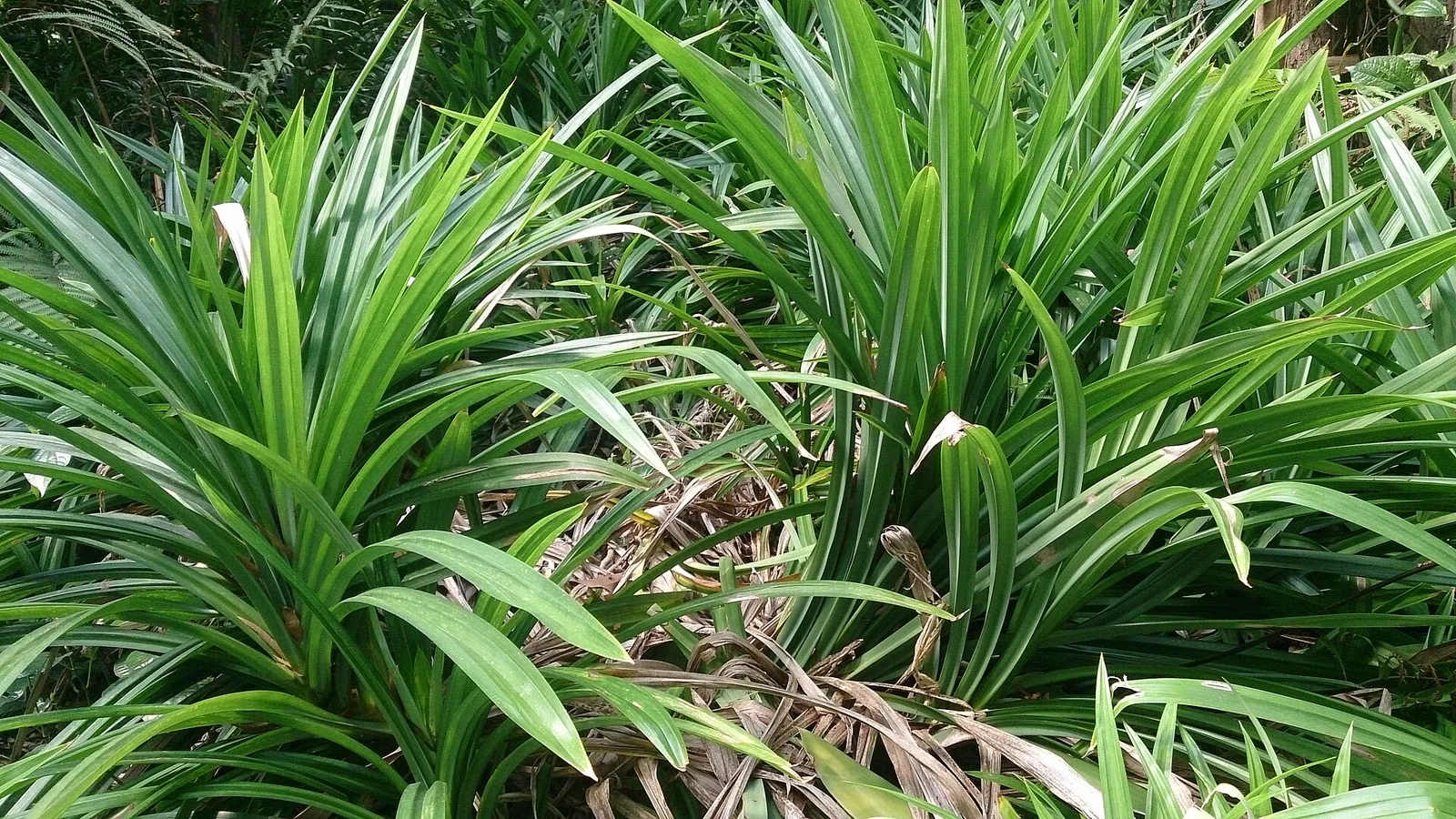
How pandan is prepared
The bruised or knotted leaves are steeped or simmered to infuse drinks, and the leaves are pounded and pressed to yield a fragrant green juice. This juice colors and flavors sweet, often coconut-based beverages and iced desserts that are sipped as drinks, and bottled pandan extract is widely used as a shortcut.
Pressurized Distillation
Distillation performed under elevated pressure to extract compounds that are difficult to capture at normal atmospheric conditions.
In depth
Origins as a Southeast Asian aromatic
Pandan is a sterile cultigen native to the warm, humid lands of Southeast Asia, propagated only by cuttings and suckers since it almost never produces viable seed. Botanists trace its likely origin to the Maluku Islands and believe it was brought into cultivation in ancient times, after which it spread across the region and into South Asia. Its prized scent comes from a single aromatic compound that also gives jasmine and basmati rice their fragrance. Long before it touched any modern beverage menu, the leaves were used to perfume rice and sweets, and that same role as a flavoring and green coloring agent carried directly into the region's sweet drinks and dessert-beverages. In Malay-speaking areas it is known as pandan or pandan wangi, and in Sri Lanka as rampe, reflecting how widely the plant traveled.[1]
Cendol and the iced sweet-drink tradition
Across both mainland and maritime Southeast Asia, pandan became central to a family of cold, sweet drink-desserts built on green jelly strands, coconut milk, palm sugar, and shaved ice. Known as cendol in Malay-speaking regions, lot chong in Thailand, banh lot in Vietnam, mont let saung in Myanmar, and nom lut in Cambodia, the dish has a long history rooted in indigenous ingredients that predate European contact. Pandan flavors and tints the worm-like jelly that gives the drink its characteristic green color, and the same pandan-perfumed coconut base appears in related Javanese beverages documented for centuries under the name dawet. Sold by street vendors, at markets, and in hawker centers, these drinks are especially popular during Ramadan for breaking the fast and feature in weddings and festivals throughout the region.[2]
Pandan in warm Southeast Asian dessert-drinks
Beyond cendol, pandan flavors a broader set of sweet, often coconut-rich preparations that straddle the line between dessert and drink. Bubur cha cha, a Betawi, Malay, and Peranakan specialty served hot or cold across Maritime Southeast Asia, simmers sweet potatoes, yams, sago pearls, and banana in coconut milk scented with pandan leaves, and is sold both as a homemade treat and as street food. In Myanmar, pandan-flavored jelly noodles appear in the cold, layered dessert-beverage shwe yin aye, and a pandan version of mont let saung is noted for its light, herbal fragrance. In these dishes the leaves are typically bruised, knotted, or steeped directly in the coconut milk so their aroma diffuses through the liquid before serving.[3]
A place alongside the region's iconic tea and milk drinks
Pandan grew up within a vibrant Southeast Asian culture of sweet, milky, and infused drinks. Among them is teh tarik, the frothy pulled milk tea developed by South Indian street vendors on the Malay Peninsula, made from strong black tea and condensed milk and theatrically poured between vessels; it stands as an unofficial national drink of Malaysia and is shared across Brunei, Singapore, Indonesia, and Thailand. While teh tarik itself is tea-based, the kopitiam and night-market settings where it thrives are exactly the places where pandan-scented sweets and cooling drinks are sold side by side, and pandan readily lends its aroma to milk-and-sugar drinks in the same tradition. This shared world of sweetened, condensed-milk beverages forms the backdrop against which pandan's drink applications developed.[4]
Pink rose drinks and mixed iced beverages
In the same milk-and-syrup family, pandan appears as a flavor in the wider Maritime Southeast Asian repertoire of sweet, brightly colored drinks. Bandung, a Singaporean creation popular across the region, mixes evaporated or condensed milk with rose syrup for a pink drink served at Ramadan iftars and weddings, often dressed up with grass jelly, lychee, or basil seed. Pandan slots naturally into this category of aromatic syrups and milk bases, and it commonly turns up in mixed iced confections such as es campur and its kin, where shaved ice, coconut, jellies, fruit, syrup, and condensed milk are combined into a spoonable, sippable cooler. In all of these, pandan contributes both its green hue and its gentle, vanilla-like fragrance.[5]
Modern global revival
In recent years pandan has drawn fresh attention well beyond its home regions. Around 2017 it gained visibility on social media, particularly in the United Kingdom, where commentators predicted it might rival matcha as a trend ingredient, though many rightly pushed back against framing a long-established Asian staple as a new discovery. That wave of interest carried pandan into contemporary cafe and bar culture, where its leaves and bottled extract flavor lattes, iced drinks, sodas, and non-alcoholic cocktails seeking a sweet, grassy, vanilla-and-coconut note. Because the essence can substitute for vanilla and the leaves yield a vivid natural green, pandan suits both no- and low-alcohol drinks that prize aroma and color. The leaves are sold fresh, dried, or frozen worldwide, allowing bartenders and drink-makers outside the tropics to infuse and color their creations.[1]
References
- [1]EncyclopediaPandanus amaryllifolius — Wikipedia↑§1↑§6
- [2]EncyclopediaCendol — Wikipedia↑§2
- [3]EncyclopediaBubur cha cha — Wikipedia↑§3
- [4]EncyclopediaTeh tarik — Wikipedia↑§4
- [5]EncyclopediaBandung (drink) — Wikipedia↑§5