Juniper
Also known as: juniper berries
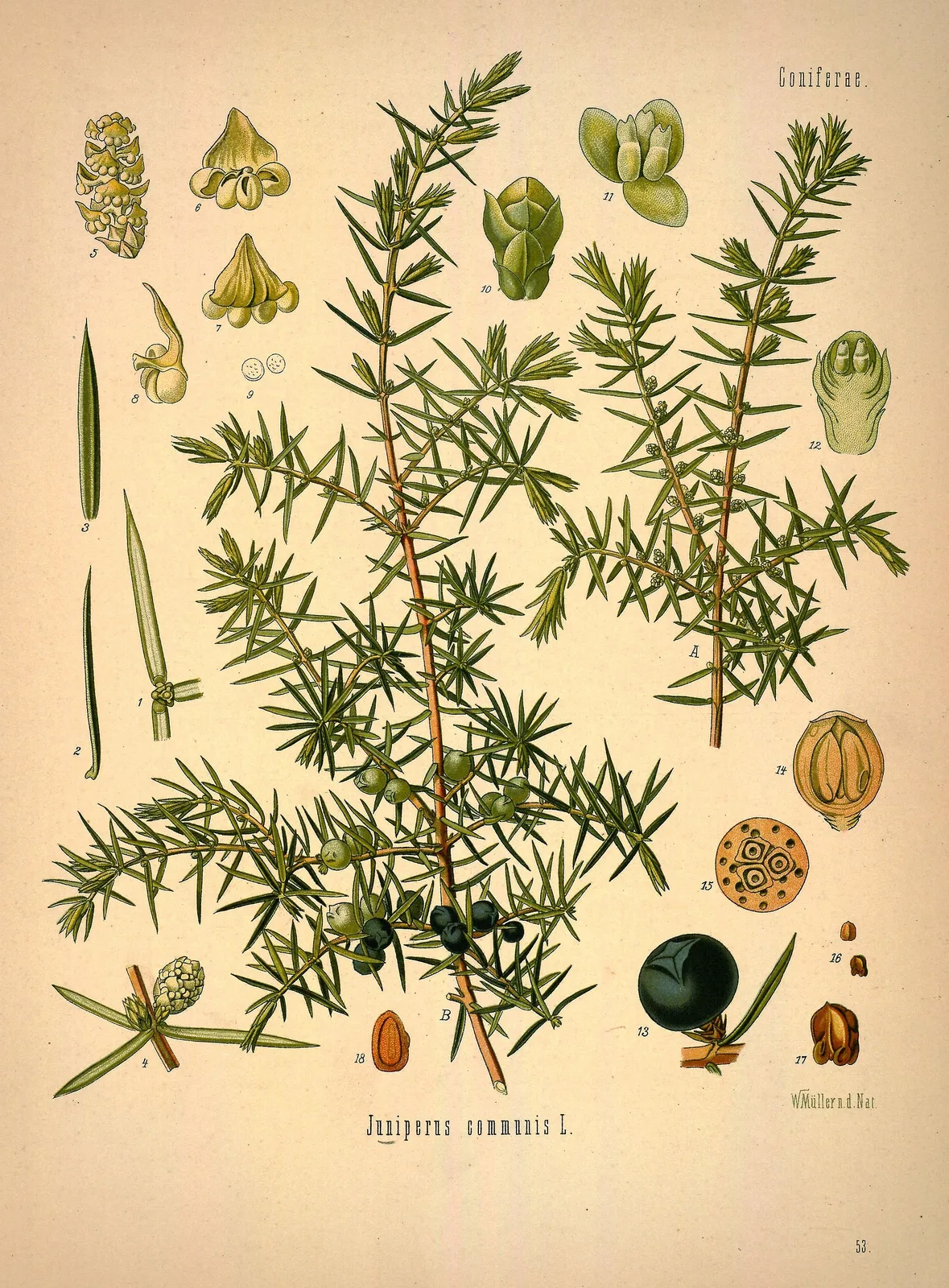
The aromatic, resinous cone-berry of the juniper shrub, an evergreen conifer whose blue or reddish 'berries' have flavored medicinal tonics, brewed ales, and distilled spirits for centuries. It is best known as the defining botanical of gin, a drink that takes its very name from the plant.
How juniper is prepared
Used to flavor distilled spirits (gin, jenever, borovička, brinjevec, Steinhäger), gin-based liqueurs (sloe gin), and farmhouse ales (sahti); the berries are also infused into nonalcoholic tonics, teas, and botanical sodas, and pair famously with quinine-bearing tonic water.
Water Kefir Fermentation
A short fermentation with water-kefir grains -- a symbiotic culture of bacteria and yeasts -- that adds gentle effervescence, body, and a soft lactic creaminess without significant alcohol.
In depth
Medieval European medicinal tonics
Juniper first entered the world of drinks as a remedy rather than a pleasure. From the Middle Ages, apothecaries and monastic distillers across Europe steeped its berries in wine and early spirits to make sharp, aromatic tonics dispensed against coughs, colds, aches, cramps, and digestive troubles. The plant carried a deep reputation as a protective herb: it was used as a charm against sickness, and plague doctors are said to have packed it into the beaks of their masks. One of the earliest written mentions of a juniper-flavored spirit appears in a thirteenth-century Flemish encyclopedic work compiled at Bruges, while a surviving printed recipe dates from a sixteenth-century distilling manual published in Antwerp. These tonic wines grew so popular that many were soon being drunk for enjoyment rather than any cure.[1]
Jenever in the Low Countries
In the Netherlands, Belgium, and neighboring parts of northern France and Germany, the medicinal juniper spirit matured into jenever, whose name traces back through Dutch to the Latin word for juniper. It was originally made by distilling malt wine, a grain-based spirit whose rough early character was masked with juniper and other herbs. Two broad styles eventually developed: oude, a smoother, maltier and sometimes oak-aged spirit reminiscent of whisky, and jonge, a lighter and more neutral style that emerged around 1900 and now dominates the market. Cities such as Schiedam, Groningen, Hasselt, and Liège became renowned production centers, and the drink today carries protected geographical status. It is traditionally poured into a tulip glass filled to the brim and sipped without lifting the glass, often accompanied by a beer chaser.[2]
Gin in England
When jenever crossed to Britain, its name was shortened to 'gin' and the spirit was reshaped into the form known today. Its rise accelerated after the Glorious Revolution of 1688 brought a Protestant king and import restrictions on French brandy, fueling the notorious Gin Craze of roughly 1695 to 1735, when cheap and often crudely flavored gin flooded London. Eighteenth-century gin was pot-distilled and maltier than modern styles, and inferior versions were sometimes cut with turpentine for added resinous bite. The softer, sweetened Old Tom style followed, and the invention of the column still in the early nineteenth century made possible the clean neutral spirit behind the London dry style. Across all these forms, juniper remained the one indispensable, legally required flavor: by definition, gin must taste predominantly of it.[1]
Gin and tonic and the colonial drink
In the tropical colonies of the nineteenth century, juniper's spirit found an enduring partner in quinine. Europeans took quinine as a malaria preventive, but its bitterness was hard to swallow, so it was dissolved in carbonated tonic water and softened with sugar, lime, and gin. The combination, popularized by Britons stationed in India, turned a medicinal regimen into a refreshing highball. Modern tonic water carries only a trace of quinine for flavor, and the drink is now built over ice and garnished classically with a wedge of lime, though contemporary serves often lean into elaborate botanical garnishes chosen to echo a particular gin. The pairing of juniper's resinous aroma with tonic's crisp bitterness remains one of the most recognizable flavor combinations in the drinks world.[1]
Central and Eastern European juniper brandies
Beyond the gin and jenever lineage, juniper anchors a family of regional spirits in Central and Eastern Europe. In Slovakia and the Czech Republic, borovička is a juniper-flavored brandy whose name derives from the Slovak word for the plant; it is clear or golden, typically bottled around 40 percent alcohol, and tastes much like a strong dry gin, made through a two-stage distillation that works from ripe berries. Its history reaches back to the sixteenth century in the Liptov region, from where it was rafted down the river Váh and exported across the Habsburg lands to Vienna and Budapest. Related juniper spirits appear among the South Slavs, including brinjevec in Slovenia and klekovača in Serbia, both named for local words for juniper. Germany has its own juniper spirit in Steinhäger, distilled in a single Westphalian town. These drinks share gin's defining botanical but follow their own distilling traditions.[3]
Sahti and Nordic farmhouse ales
Juniper has also long served brewers rather than distillers. In Finland, the traditional farmhouse ale sahti is flavored with juniper in addition to or instead of hops, and the mash is filtered through a bed of juniper twigs laid in a trough-shaped wooden tun called a kuurna. The result is a cloudy, lightly carbonated beer, often carrying a banana note from baking yeast and balanced by the resinous bitterness of the juniper branches. Brewed for generations on farms and now also produced commercially, sahti holds protected status in Europe, meaning the name requires something close to the traditional ingredients and process. Closely related juniper-touched farmhouse ales survive on the Swedish island of Gotland and the Estonian islands, and the style has inspired craft brewers abroad who reinterpret it with juniper berries and branches.[4]
Gin liqueurs and the modern revival
Gin has long served as a base for infused liqueurs, the best known being sloe gin, made by steeping the tart blackthorn drupes with sugar in gin until the spirit turns a deep ruby red. Although built on a juniper spirit, it is unusual in being permitted to carry the word 'gin' without the 'liqueur' suffix under European rules. Similar fruit infusions, such as damson gin, follow the same homemade tradition. Since around 2013 the wider category has surged worldwide, with a flood of new producers and a profusion of flavored, often colored gins and gin liqueurs. This revival has spilled into the low- and no-alcohol sphere, where juniper's piney, citric character is steamed, infused, or compounded into nonalcoholic botanical spirits, tonics, and craft sodas designed to capture the familiar taste of gin without the alcohol.[1]